Journal · Science
Einstein@Home: lending a computer to the pulsar hunt
At 2:07 on a Sunday morning our computer started searching gamma-ray data for spinning dead stars. Three days earlier, a team had found one with ten hours of computing that the previous best method would have needed six hundred years for.
When a giant star runs out of fuel, it can fall in on itself and become a tiny, heavy ball. The ball is only about as wide as a city, but it weighs more than our Sun. Some of these dead stars spin very fast, hundreds of times a second, and sweep out beams like a lighthouse. Scientists call them pulsars.
Pulsars are hard to find. Telescopes in space catch tiny bits of light from them, sometimes only a few a day. Detectors on Earth listen for gravitational waves, tiny stretches in space itself. Finding the beat of a spinning star in all that data takes a lot of computer work.
So scientists cut the work into small pieces. Then they ask people to lend their computers when they are not using them. Our computer is now one of them. Tonight it is checking light from a space telescope called Fermi. It is looking for the beat of a spinning dead star.
Einstein@Home is a volunteer computing project. People lend it the spare time on their computers, and it uses that time to search data from telescopes and gravitational-wave detectors for pulsars, which are the collapsed cores of dead stars, some spinning hundreds of times a second. The search is too large for any one institution to run, so it is cut into small pieces and sent to whoever has offered a machine. The project is run by the Max Planck Institute for Gravitational Physics and the University of Wisconsin–Milwaukee, and the institute counts more than 80 new pulsars found this way.
We joined in the early hours of 22 November 2026. This is what that looks like, what the computer is actually doing, and why the timing turned out to be interesting.
- Orange crosshair
- The point in the sky this piece of work is searching. It moves from point to point as the search goes on.
- Yellow lines and white dots
- The constellations. They look backwards because you are looking at the sky from outside the globe.
- Purple dots
- Known pulsars, already found with telescopes. Most crowd along the Milky Way, towards the middle of our galaxy.
- Dark red dots
- Known supernova remnants, clouds left by exploded stars. A spinning dead star may still sit inside one.
- Small L-shaped marks
- The point straight overhead of each observatory whose data the project uses: the LIGO detectors at Hanford and Livingston, GEO600 in Germany, Virgo in Italy and the Arecibo radio telescope. They drift across the stars over a day as the Earth turns.
- Clock, top right
- The time in UTC: 07:23 here was 2:23 AM in North Carolina.
- BOINC Statistics, bottom left
- Our name on the project and the credit earned so far.
- Search Information, bottom right
- Where the crosshair is pointing, in sky coordinates, how much of this task is done, and the processor time it has used.
What the computer is doing
The project's software, BOINC, attached to Einstein@Home at 2:07 AM, downloaded its files and
started its first task within the minute. That task belongs to the project's Gamma-ray
pulsar search #5. It runs on the Mac's processor, not its graphics chip, because the
project ships this search for Apple's chips as a processor-only program. The task's name begins
LATeah: its data comes from the Large Area Telescope on NASA's Fermi Gamma-ray Space
Telescope, which has been in orbit since 2008.
The same first batch included work for the graphics chip, from a different search, the Binary Radio Pulsar Search, whose name lists the Arecibo and Green Bank telescopes, and a second graphics task followed a minute later. The tasks turned out to be a recording made at Arecibo on 30 June 2016. At 2:14 AM both were downloaded and waiting. They had not started, so we make no claim yet about how this Mac's graphics chip performs on them.
The map below shows where the data comes from: the telescopes and detectors behind our Mac's tasks and the rest of the project's searches.
Where the data comes from
Tap a marker to see the telescope or detector.
- Our Mac's data so far
- Also used by Einstein@Home
- Named on the screen or in the search's title
- Our Mac, in Boone
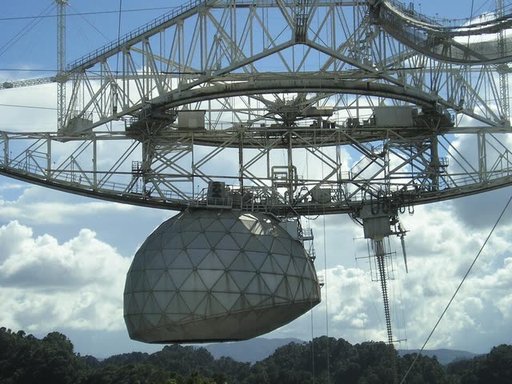
Our Mac's data so far
Arecibo Telescope, Puerto Rico
A 305 m radio dish built into a natural sinkhole, the largest single dish in the world for 53 years. It collapsed in December 2020, weeks after its closure was announced. The radio tasks our Mac finished came from a recording made here on 30 June 2016, so volunteers are still searching data it gathered years ago. The photo shows the receiver platform that hung above the dish.
Image: Alessandro Cai (OliverZena), Wikimedia Commons, Public domain.

| Read at 2:14 AM, 22 Nov 2026 | Value |
|---|---|
| Computer | Apple M5 Max, 40-core graphics |
| Software | BOINC 8.2.11 for macOS |
| Running | 1 gamma-ray task (processor), 5.1 minutes in |
| Waiting | 2 radio tasks (graphics chip) |
| Credit granted | 0 |
| Hours given | Not yet counted |
Credit stays at zero for a while by design. Einstein@Home sends each piece of work to more than one computer and grants credit once the answers have been checked against each other, so a single faulty machine cannot put a wrong result into the search. Our task list on the project's site showed all three tasks in progress, each due back by 6 December 2026, two weeks after it was sent. We will count our hours from BOINC's own task logs, and this page will only show a number once the logs show it.
How big Einstein@Home is
Einstein@Home publishes its own server status page. At 7:15 UTC on 22 November 2026, a few minutes after our first task started, it showed:
| 22 Nov 2026, 07:15 UTC | Value |
|---|---|
| Participants active in the last two weeks | 13,061 |
| Computers active in the last two weeks | 23,829 |
| Processor cores on those computers | 349,196 |
| Computing speed, estimated from credit | 30,453.6 teraflops |
| Pieces of work finished in the last week | 1,729,437 |
| Computers with Apple graphics, last 7 days | 1,368 |
About 30 petaflops is comparable to a large supercomputer, assembled from people's spare time. The project derives the figure from the credit it grants rather than measuring it, so it is an estimate. The chart below sets it beside the world's fastest machines, with the reason the comparison is rough.
Einstein@Home against the world's fastest computers
- 1LineShineChina2,198.40
- 2El CapitanUnited States1,809.00
- 3FrontierUnited States1,353.00
- 4AuroraUnited States1,012.00
- 5JUPITER BoosterGermany1,000.00
- 6HPC7Italy571.50
- 7EagleUnited States561.20
- 8HPC6Italy477.90
- 9FugakuJapan442.01
- 10AlpsSwitzerland434.90
- 82MUSICA Phase 1Austria31.84
- 83HunterGermany31.68
- ~Einstein@Home volunteersestimate, 22 Nov 202630.45
- 84Voyager-EUS2United States30.05
- 85CrossroadsUnited States30.03
- 86PITAGORAItaly27.90
The list is TOP500, November 2026. Its petaflops come from one benchmark, a large linear-algebra problem in full 64-bit arithmetic. Einstein@Home's 30.45 petaflops is the project's own estimate from the credit it grants, for different work. So this places it among the machines; it does not earn it a rank. Our Mac's graphics chip could not even run that benchmark: it cannot do 64-bit arithmetic at all.
The search our Mac is working on, the gamma-ray search #5, is the largest single block of that work: 760,694 pieces finished in the last week, and 228,413,119 of the 264,779,274 units it needs done, which is 86 per cent. The project estimates 239 days remaining. The same page showed 4,247 tasks queued and ready to send, and our Mac received one.
Why gamma-ray pulsars are hard to find
A radio telescope pointed at a pulsar sees a strong pulse every turn. Fermi does not. It collects gamma rays one photon at a time. The pulsar that this week's paper found was identified from about 16,000 photons gathered over about 15 years, which averages about three a day.
To prove those photons come from a spinning star, a search has to find the exact rotation that lines them all up, and that means guessing several things at once: how fast the star spins, how quickly it is slowing down, and precisely where it sits in the sky. Get any of them slightly wrong and, over fifteen years, the pulses smear into noise. The Max Planck institute describes the old approach as a four-dimensional grid with millions of trial values in each direction, which is why finding a single pulsar used to take hundreds of computer-years, and why the work was handed to volunteers in the first place.
The toy below is a tiny version of that search. It guesses only the spin, so you can do it by hand, and then lets the computer try a thousand guesses.
Try it: find the beat
A pulsar is a dead star that spins. Its two beams sweep around like a lighthouse, and Earth sees a flash each time one passes. This one is slowed down a lot. Real ones can turn hundreds of times a second.
1. What the telescope gets. Each tick is one bit of light, over 30 seconds. Some came from the star and most did not. You cannot tell which by looking.
2. Guess how fast the star spins. The computer stacks every tick by where the star was in its turn when it arrived. A wrong guess smears them flat. The right guess makes a tall pile.
Move the slider, or let the computer search.
3. Let the computer do it. Moving the slider by hand is slow. A computer tries every guess and keeps the best.
The new method
On 19 November 2026, Physical Review Letters published "Gamma-ray pulsar discovery using a lattice-based method" by D. Pook-Kolb, D. Gazith, C. J. Clark, E. Agrell, B. Zackay and B. Allen, from the Max Planck Institute for Gravitational Physics in Hannover, the Weizmann Institute of Science and Chalmers University of Technology.
Instead of stepping through a grid, the team turned the search into a geometry problem: finding the shortest vector in a lattice, a regular array of points in many dimensions. That is a problem cryptographers have studied intensively, because some of the encryption designed to survive future quantum computers depends on it being hard. The pulsar search borrows their algorithms for solving it. Nothing about it involves breaking codes.
The first result is a millisecond pulsar called PSR J1622-7204, spinning 261 times a second, which the most sensitive earlier method had missed. Each trial of the new algorithm took about five minutes on one processor core, and the whole discovery took the equivalent of about ten hours on one core. The institute and NASA both put the previous best method at about six hundred years.
That is the leap in this result. Bruce Allen's announcement to volunteers describes the new method as about a million times faster and more efficient than the previous state of the art. A search that was out of reach for any single computer now takes less than a day on one processor core, and the team's next step is to put it to work on Einstein@Home.
What it means for volunteers
J1622-7204 is a single star. The harder prize is a pulsar orbiting a companion, because the orbit adds more unknowns to every guess. Until now, finding a gamma-ray pulsar in a binary system meant first measuring its orbit with an optical telescope. The team's stated next step is to combine the lattice method with Einstein@Home to search for binary pulsars without that, and the institute notes that this search will again need far more computing.
Bruce Allen, the project's director, told volunteers on 19 November that he hopes an adapted version will be running on their computers within a few months, after a good deal of testing, and that it is not yet known whether it will run on processors, graphics chips or both. So the task on our Mac tonight is the established search, not the new one. When the new search ships, the same Mac will pick it up without anyone doing anything, which is the point of volunteer computing.
Volunteers and the project team are celebrating this result in the director's announcement thread on the Einstein@Home forum. We asked long-time volunteers what first made them feel part of it, and you are welcome to add your own answer: join the conversation on the Einstein@Home forum.
How to join Einstein@Home with BOINC
BOINC is free and comes from the University of California, Berkeley at boinc.berkeley.edu. Install it, choose Einstein@Home from its list of projects, and create an account there. You can set it to run only while the computer is idle and to stop when you are using it. It does use electricity: a computer working flat out draws more power than one asleep, so it is worth deciding how many hours you are happy to give.
Our Mac crunches for the Highland Willow team on Einstein@Home, founded on 22 November 2026. Anyone is welcome to join: once your computer is attached, open the team's page and choose "Join this team". Every task you finish then adds to the team's total as well as your own.
Log
22 November 2026, 2:14 AM. Attached at 2:07. One gamma-ray task running on the processor, two radio tasks waiting for the graphics chip, all three due back by 6 December, no credit yet. Not yet on a team.
22 November 2026, 3:26 AM. The first gamma-ray task finished and sent back its results. It ran for 41 minutes, spread over the 78 minutes since it started, because BOINC paused it for part of that time. The graphics chip started work at 3:21 and finished two radio tasks in about two and a half minutes each. All three now wait for a second computer's answer before any credit. Computing given so far, counted from BOINC's own logs: 46 minutes. Still to do on this Mac: 51 radio tasks and 2 gamma-ray tasks.
22 November 2026, 4:16 AM. The second gamma-ray task finished after 49 minutes of running. By then the Mac had finished 22 tasks, 2 gamma-ray and 20 radio, adding up to 2 hours 25 minutes of running time in BOINC's own job log. Tasks run side by side, so that is more than the clock time since 2:07; since 3:33 BOINC has been running 17 gamma-ray tasks at once. And the first credit arrived: 62.5, which means at least one of our answers matched another computer's. Just before it, the project's own task page listed 18 of our tasks as reported, every one marked "Completed, waiting for validation", with each radio task taking between 141 and 245 seconds.
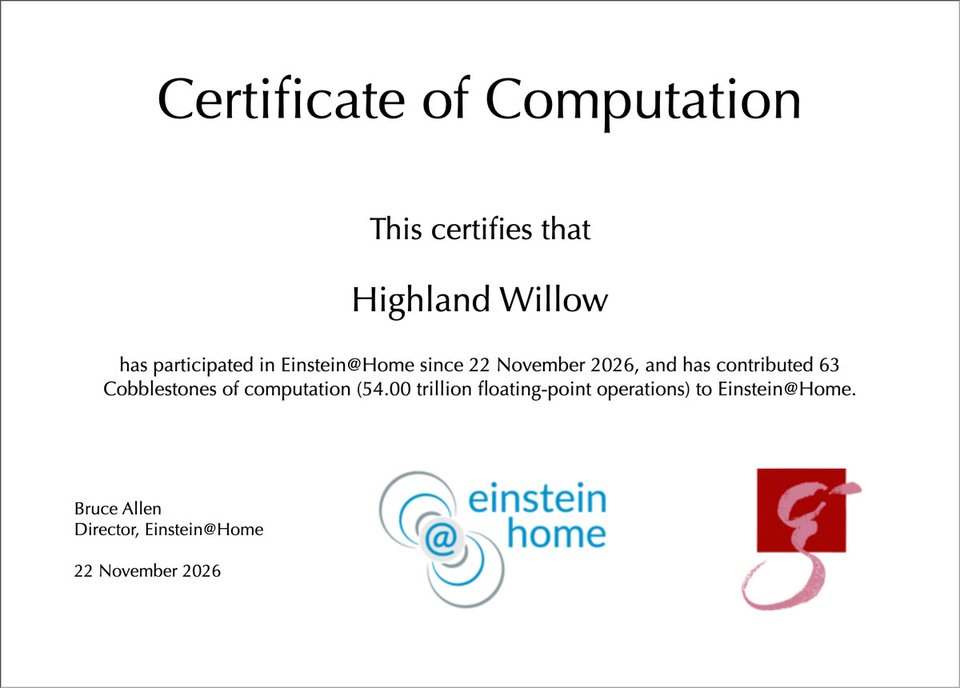
22 November 2026, 4:30 AM. Einstein@Home issued our first certificate of computation, in the name of its director, Bruce Allen. It says Highland Willow has taken part since 22 November 2026 and has contributed 63 Cobblestones, the project's unit of credit, equal to 54 trillion floating-point operations.
22 November 2026, 11:35 AM. Nine and a half hours in, the Mac has finished 227 tasks, 93 gamma-ray and 134 radio. BOINC's job log adds their running time up to 125 hours, far more than the clock time, because so many run at once. The project's task list now shows 44 of our tasks checked and valid, 174 reported and waiting for a second computer's answer, 247 still with us, and none invalid or in error. Each valid gamma-ray task earned 693 credits and each radio task about 62. The account page now puts our total credit at 10,947, earning about 1,077 a day on recent average. The project's page for our computer lists its 18 processor cores and 128 GB of memory, and says our tasks come back in 0.21 days on average, about 5 hours from download to report.
22 November 2026, 12:30 PM. A second certificate, and a much bigger number: 16,485 Cobblestones, which Einstein@Home equates to 14.24 quadrillion floating-point operations. Our credit rose by 5,538 in under an hour, as other computers caught up and checked the tasks that were waiting for a second answer. The project has now sent this Mac 542 tasks.
22 November 2026, 12:45 PM. We opened a second account, with Rosetta@home, the University of Washington project that studies and designs proteins, the same field as our own protein folding study on this Mac. It has no tasks to hand out today: its status page, last refreshed at 12:20, shows nothing waiting and nothing out. So the Mac is not signed up there yet, and all its spare time still goes to Einstein@Home.
Rosetta's own last update, in March 2025, explains the quiet. AI models such as AlphaFold now predict most protein shapes, so the research has moved on from working out how proteins fold to designing things with them: small drug-like molecules and unusual peptides for drug discovery, which those models still handle poorly. Volunteers on its forum describe what that means for home computers: work now arrives in small, occasional batches that are gone within an hour, sometimes with months between them.
22 November 2026, 1:35 PM. Our total credit is now 20,825, earning about 2,044 a day on recent average. Another 194 finished tasks are waiting for a second computer to check them, 72 gamma-ray and 122 radio. Every task checked so far has earned a fixed amount, 693 for gamma-ray and 62.5 for radio, so the tasks waiting hold about 57,500 more credit, which should arrive as other computers catch up. The project has now sent this Mac 578 tasks: 81 checked and valid, none invalid or in error, and 303 still being worked on.
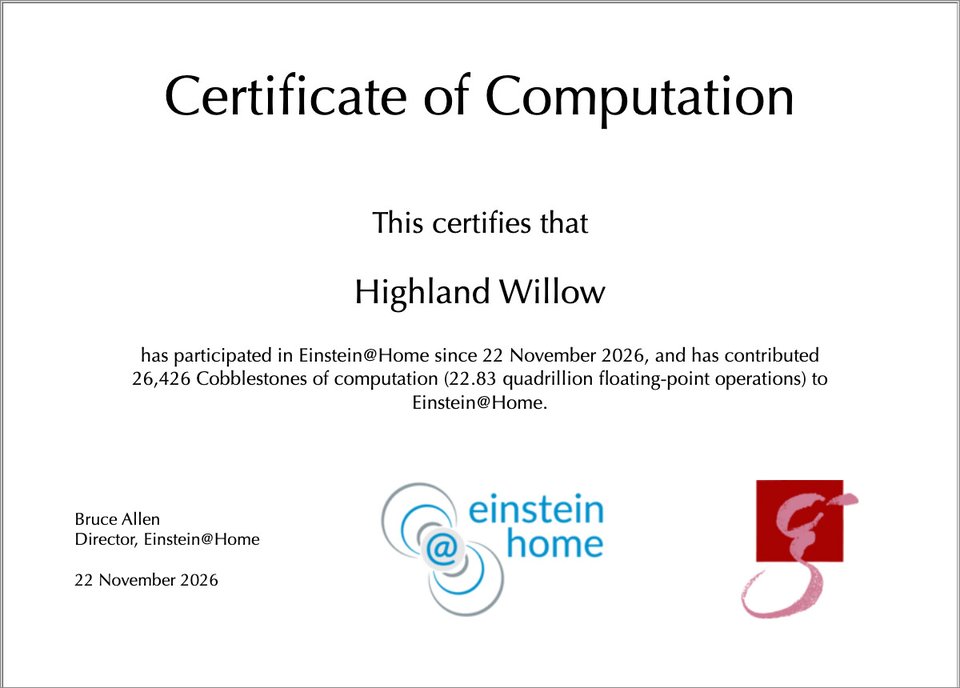
22 November 2026, 2:14 PM: twelve hours in. In its first twelve hours on the project the Mac finished 293 tasks: 98 gamma-ray searches on the processor and 195 radio searches on the graphics chip. BOINC's job log adds their running time up to 133 hours, about eleven times the clock time, because many tasks run side by side. Gamma-ray tasks have settled at about 76 minutes each, against 41 and 49 minutes for the first two, now that the Mac runs many of them at once; a radio task takes about four minutes. At the end of the twelve hours our total credit stood at 26,426, earning about 2,591 a day on recent average. 100 tasks were checked and valid, none invalid or in error, and another 193 were finished and waiting for a second computer's answer, worth about 53,700 more credit if they all pass. Beyond the computing, the first twelve hours also brought a profile, the Highland Willow team and our first post on the project's forum.
22 November 2026, 4:57 PM. Our total credit is now 37,998, up 11,572 since the twelve-hour mark, and the recent average has climbed to about 3,702 a day as more of our work gets checked. 154 tasks are checked and valid, 45 gamma-ray and 109 radio, still with none invalid or in error. Another 204 finished tasks, 74 gamma-ray and 130 radio, are waiting for a second computer's answer, worth about 59,400 more credit if they all pass. In just under fifteen hours the project has sent this Mac 616 tasks.
22 November 2026, 10:04 PM. Almost twenty hours in, our total credit has reached 58,187, up 20,189 since late afternoon, and the recent average is now about 5,605 a day. 245 tasks are checked and valid, 68 gamma-ray and 177 radio, and there is still not a single invalid task or error. Another 246 finished tasks, 88 gamma-ray and 158 radio, are waiting for a second computer's answer, worth about 70,900 more credit if they all pass. The project has now sent this Mac 810 tasks.
23 November 2026, 1:49 AM. Just short of a full day in, our total credit has reached 69,310, up 11,123 since the late-evening entry, and the recent average is now about 6,613 a day. 312 tasks are checked and valid, 79 gamma-ray and 233 radio, and there is still not a single invalid task or error. Another 263 finished tasks, 86 gamma-ray and 177 radio, are waiting for a second computer's answer, worth about 70,700 more credit if they all pass. The project has now sent this Mac 871 tasks.
23 November 2026, 2:08 AM: one full day. Twenty-four hours after we joined, our total credit is 69,560 and the recent average is about 6,633 a day. In that first day the Mac finished 584 tasks: 165 gamma-ray tasks on the processor, typically about 76 minutes each, and 419 radio tasks on the graphics chip, typically about 3 minutes each. 316 are checked and valid, 79 gamma-ray and 237 radio, with not one invalid task or error. Another 261, 86 gamma-ray and 175 radio, are waiting for a second computer's answer, worth about 70,500 more credit if they all pass.
Show the numbers
| After | Gamma-ray | Radio |
|---|---|---|
| 2 h | 1 | 15 |
| 4 h | 19 | 52 |
| 6 h | 39 | 82 |
| 8 h | 75 | 112 |
| 10 h | 94 | 147 |
| 12 h | 98 | 192 |
| 14 h | 117 | 227 |
| 16 h | 137 | 261 |
| 18 h | 144 | 305 |
| 20 h | 156 | 341 |
| 22 h | 161 | 377 |
| 24 h | 165 | 419 |
The first day in numbers. Everything we measured over the first 24 hours, by type of task. The power line is one short reading of the two chips, priced at 13 cents a kilowatt-hour, our electric rate; it was taken while BOINC was running only one task of each kind, so it is not yet the cost of crunching.
| First 24 hours | Gamma-ray FGRP5, CPU | Radio BRP4A, GPU | All |
|---|---|---|---|
| Tasks | |||
| Finished on the Mac | 165 | 419 | 584 |
| Finished per hour, average | 6.9 | 17.5 | 24.3 |
| Finished per hour, busiest hour | 18 | 24 | |
| Run time per task, minutes | |||
| Mean | 74.4 | 3.24 | |
| Standard deviation | 6.0 | 0.85 | |
| Shortest | 41.1 | 2.34 | |
| Lower quartile | 76.1 | 2.46 | |
| Median | 76.4 | 2.94 | |
| Upper quartile | 76.8 | 3.99 | |
| Longest | 78.9 | 8.54 | |
| Total run time, hours | 204.7 | 22.6 | 227.3 |
| Processor time per task, minutes | |||
| Mean | 58.2 | 2.60 | |
| Median | 59.3 | 2.48 | |
| Processor time as a share of run time | 78% | 80% | |
| Checks and credit at 24 hours | |||
| Checked and valid | 79 | 237 | 316 |
| Waiting for a second computer | 86 | 175 | 261 |
| Invalid or errors | 0 | 0 | 0 |
| Credit per valid task | 693 | 62.5 | |
| Credit granted | 54,747 | 14,813 | 69,560 |
| Share of credit granted | 79% | 21% | 100% |
| Planned computation, quadrillion operations | 17.3 | 7.3 | 24.7 |
| Power, one short reading, not a crunching measurement | |||
| Processor and graphics chip, 2-minute reading | 44 W | ||
| If they drew that all day | 1.06 kWh | ||
| That energy at 13 cents a kWh | $0.14 | ||
Tasks, run times and processor time are from BOINC's own job log on our Mac, 2:07 AM 22 November to 2:08 AM 23 November 2026. Finished counts our Mac's own completions, so it is a little higher than valid plus waiting, which counts what the project has received. Checks and credit are from our account at 2:08 AM. Planned computation is the project's own estimate of the work in each task, not a count of what the Mac did. The power reading is the processor and graphics chip only, macOS's own estimate over 24 one-second samples at about 2:56 AM, while BOINC was running one processor task and one graphics task alongside other work on the Mac, so it is not the power used by crunching; a reading with all cores crunching is still to come. The whole computer, with its memory, storage, screen and fans, draws more.
Show the numbers
| Time | Granted | Waiting | If all pass |
|---|---|---|---|
| 2:07 AM | 0 | not read | |
| 11:35 AM | 10,947 | not read | |
| 12:30 PM | 16,485 | not read | |
| 1:35 PM | 20,825 | 57,521 | 78,346 |
| 2:14 PM | 26,426 | 53,676 | 80,102 |
| 4:57 PM | 37,998 | 59,407 | 97,405 |
| 10:04 PM | 58,187 | 70,859 | 129,046 |
| 1:49 AM | 69,310 | 70,660 | 139,970 |
| 2:08 AM | 69,560 | 70,536 | 140,096 |
Sources
- Allen, B. Breakthrough method to search for gamma-ray pulsars. Einstein@Home, 19 November 2026. einsteinathome.org
- Max Planck Institute for Gravitational Physics. Finding gamma-ray pulsars a million times faster, 19 November 2026. aei.mpg.de
- NASA Science. Fermi data and a pulsar discovery, 19 November 2026. science.nasa.gov
- Einstein@Home. Server status, page updated 22 November 2026, 07:15 UTC. einsteinathome.org/server_status.php
- Einstein@Home. The screensaver. einsteinathome.org/science/screensaver
- Pook-Kolb, D., Gazith, D., Clark, C. J., Agrell, E., Zackay, B. and Allen, B. Gamma-ray pulsar discovery using a lattice-based method. Physical Review Letters (2026). doi:10.1103/vlt2-xzgk
- Our own figures: BOINC's state and logs on our Mac, read 22 November 2026 at 2:14 AM Eastern.
Further reading
Other BOINC projects. The same free BOINC program can lend a computer to other research too. A few from BOINC's own list, each with what it was doing when we read its own pages, around noon Eastern on 22 November 2026. These numbers change by the hour.
- Asteroids@home: the shapes and spins of asteroids. Charles University, Prague. Now: about 411,000 tasks out with volunteers. In October it published around 30,000 new asteroid shape models, and it is now preparing data for the Gaia space telescope's next catalogue.
- Gaia@home: asteroid shapes worked out from their changing brightness. Adam Mickiewicz University, Poznań. Now: relaunched on 2 November 2026 with a new method; about 16,000 tasks out and 1,600 waiting for a computer.
- Kessler@home: the future of space debris in low Earth orbit, simulated up to 200 years ahead. NASA Goddard Space Flight Center. Now: live since 6 November 2026, with 7,218 of 302,400 planned scenarios done, about 37,000 tasks out and 23,000 waiting. Versions for more graphics chips are in testing.
- Milkyway@home: models of the shape of our galaxy. Rensselaer Polytechnic Institute. Now: about 137,000 simulation tasks out, modelling the Sagittarius stream, a trail of stars pulled from a smaller galaxy. Its status page was last refreshed on 19 November.
- LHC@home: physics for the Large Hadron Collider. CERN. Now: back after an upgrade on 17 November; about 10,300 tasks out, most of them simulations for the ATLAS experiment, and 2,700 waiting. Our Mac is signed up here too, set to take no new work.
- Climateprediction.net: climate models. University of Oxford. Now: quiet. 224 tasks out, almost all a weather model set up for cities, and none waiting. Its latest news is from August 2025.
- Rosetta@home: how proteins fold. University of Washington. Now: no work. Its servers are running, but no tasks are out or waiting. Its last update, in March 2025, said it was moving from predicting protein shapes to designing small drug-like molecules and peptides.
- World Community Grid: medical, environmental and humanitarian research. Krembil Research Institute. Now: we could not tell. Its website would not show us its news or status on 22 November.
- Science United: pick the areas of science you care about and it chooses the projects. University of California, Berkeley. Now: it has no status of its own; what you receive depends on the areas you choose.
- The full list: boinc.berkeley.edu/projects.php